

The chief executive of a sector body has urged charity trustees to prevent their chairs from becoming “gatekeepers” and called for a shift in behaviour to avoid conflict.
Debra Allcock Tyler, Directory of Social Change CEO, criticised leadership structures at charities where chairs make decisions without consulting boards.
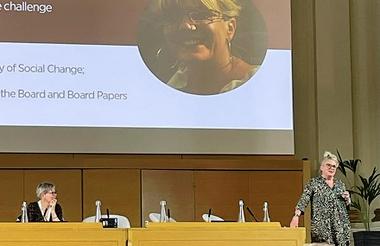
Speaking at Civil Society Media’s Trustee Exchange 2026 in BMA House, central London, Allcock Tyler said that problems, including trustee infighting, stemmed from patriarchal and hierarchical board governance.
Following a survey by nfpResearch last month, which found that most people would not consider being a charity trustee, Allcock Tyler said the role was demanding and called for better behaviour on boards to make it more appealing.
“Trustees get murderous,” she said. “I’ve known trustees to have punch-ups because people get very passionate, particularly if it’s a cause-led charity.
“In my experience, poor governance has very little to do with structure and everything to do with behaviour.
“Often, it’s the way in which questions are asked that causes the damage, it’s not the question itself. Are we asking questions in inquiry mode or in catching out mode?”
Allcock Tyler said trustees speaking poorly to each other, refusing to budge on positions and failing to consider themselves as part of a collective were persistent problems.
She said that an approach to governance where board members report down was unsuited to the charity sector.
“If your chair becomes the gatekeeper, which happens a lot, and they’re making decisions without coming back to the board […] and the charity goes under for whatever reason, every single one of the members of that board will be held equally accountable,” she said.
“Saying ‘I didn’t know, I wasn’t told’ doesn’t cut it because the question will come back at you as well.”
Allcock Tyler added that chairs should not have to line-manage their charity’s CEO.
‘Cut the paperwork’
Allcock Tyler called for bureaucracy to be reduced and said most board agendas “are absolutely dreadful”.
“They tell you nothing,” she said. “Cut the paperwork – detail is not information.”
She said board members should attend meetings with information, questions and facts, rather than a combative attitude.
“Don’t come ready to take somebody down: if you’re coming ready to attack you’re never going to win the argument,” she said.
She added that managing oneself was the hardest part of being an effective charity trustee, but said improving this skill could lead to better meeting outcomes.
“If you want to manage better behaviour on your board, start with yourself, because you can’t control anybody else’s behaviour; you can control your own,” she said.
“If you take away the need for people to defend their position, if you use the term alignment rather than agreement, so people don’t come to say I was wrong, you were right, people find it much easier to let go of the things that they were hanging onto for dear life."
Allcock Tyler said that charity boards should demand more, including access to funding, and said there was money available despite common perception.
“I’m sick to death of people saying there’s no money,” she said.
“We’ve gotten used to, in our sector, accepting this narrative that there just isn’t any money so we don’t ask, we don’t argue back, we don’t answer the question.”