


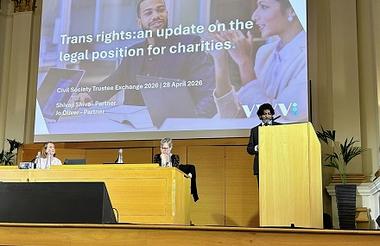
Charity trustees are not expected to “resolve the moral debate” over trans inclusion in the wake of the For Women Scotland ruling, but must be able to evidence robust decision-making, lawyers have advised.
VWV partners Shivaji Shiva and Joanne Oliver presented a session at Civil Society Media’s Trustee Exchange conference this week on the implications of the Supreme Court’s decision in the case, which clarified that sex under the Equality Act refers to biological sex, not gender identity.
They said the lack of clear guidance in the wake of the ruling – something the Charity Commission called for in January – means there is ongoing uncertainty for charities in relation to workplace facilities, membership criteria and service provision.
Trustees must therefore balance the rights and interests of different protected characteristics including sex, gender reassignment, religion or belief and more, they said.
Need for ‘lawful, proportionate and evidence-based decisions’
Shiva said this is “not an area where trustees are being expected to resolve a moral debate”.
He added: “They are asked to make lawful, proportionate and evidence-based decisions in the context of their particular organisation, its charitable objects and the circumstances surrounding it.”
Oliver noted that some groups “have interpreted the decision as a ban on trans people using single-sex spaces and services and, more generally, an erosion of trans rights”.
But, she said: “The judgment doesn’t remove any protections afforded to transgender men and women, and they remain covered by protection under the protected characteristic of gender reassignment.
“This essentially means someone who is proposing to, or is undergoing, or has undergone a process to change their gender is protected from discrimination,” she added. “Importantly, they don’t need to have undergone any medical treatment.”
Trustees must be alive to the fact that decisions about facilities, policies and working arrangements may engage the rights of people with different protected characteristics simultaneously, Oliver said.
Provision of facilities as an employer
Provision of facilities such as toilets is one of the trickiest areas for employers, Oliver said. The legal framework governing this is the Workplace Health, Safety and Welfare Regulations 1992, which essentially requires employers to provide separate facilities for men and women as a minimum standard.
In light of the Supreme Court case, charities should expect their facilities could be open to more challenge under the Equality Act from people wishing to preserve female-only spaces for use by biological women, and from others who are potentially excluded as a result of decisions made.
“Providing a range of facilities so no one’s excluded is a really important first step,” Oliver said. “But that doesn’t necessarily work for every workplace and for every charity.”
She cited factors such as restricted space and the potentially “prohibitive” cost of extra facilities as “things that have to be factored into your decision-making”.
Oliver also emphasised that the regulations cover only the provision of facilities: “They’re not about how you police those facilities… there’s no duty to police who uses them.”
Policies and training
Facilities policies must be clear, risk-assessed and communicated properly to staff, Oliver added. Policies on harassment, bullying, diversity, inclusion of trans colleagues should reinforce the importance of respect and inclusion, both for trans colleagues and also colleagues holding gender-critical beliefs.
She said charities should ensure staff have training in equality, anti-harassment and unconscious bias, and managers be trained to recognise and resolve workplace conflicts before they escalate.
“In these circumstances, a fair, objective process really does matter [as much as outcome],” she said.
“Decisions made in haste, informed by prejudice or without proper investigation are far more likely to unravel in a tribunal than those made calmly and consistently.
“And don’t dismiss complaints out of hand. Every grievance should be investigated fairly without assumptions about motive, credibility or outcome.”
Oliver concluded: “Employment issues in this space are rarely about finding the perfect answer. They’re about showing an organisation acted in a balanced and thoughtful way.”
She characterised good governance as being about clear policies, good training, proper records and the confidence to hold difficult conversations early.
“Don’t shy away from these conversations – it’s really important to engage, and that helps to avoid things escalating into disputes, resignations and ultimately litigation,” Oliver said.
“Recent cases demonstrate that tribunals are less concerned with whether an employer chose inclusion or exclusion [than] whether the employer properly identified competing legal rights, gathered evidence about impact and disadvantage, considered alternatives and handled concerns fairly and respectfully.”
In deciding what approach to take, “trustees can’t just copy another organisation’s answer”, Shiva added. “There really is a need to engage carefully with all of these factors, and that points us back to good governance, and the consideration of objects, particular needs and demonstrable needs of beneficiaries, the structure of the organisation and the risks facing it.”