

The government’s impact economy programme could risk excluding small charities less able to evidence the effect of their work, a sector leader has warned.
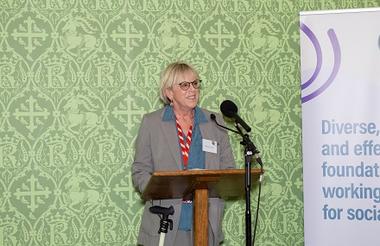
Speaking at an Association of Charitable Foundations (ACF) event in the House of Commons yesterday, Baroness Polly Neate said it was both a time of “great opportunity” and “peril” for civil society.
Since stepping down as chief executive of Shelter a year ago, Neate has coached more than 30 sector leaders and said “the job is definitely getting harder” as charities come under “intense pressure, both financial and cultural”.
She now convenes the Social Insights Panel for the Future Governance Forum, which last week called for a commissioning overhaul to better engage civil society in public service delivery, particularly those doing preventative work.
Reflecting on the need for more funding for prevention at yesterday’s event, as well as the government’s new Office for the Impact Economy, Neate said: “I truly believe only truly local, community-led, often highly specialist organisations can deliver on that.
“This all makes me worry a bit about the idea of impact economy, if it suggests that these absolutely essential, small, community-based groups and organisations who are people’s entry points into that web of support must have the resources to measure and prove their impact, because they don’t.
“They just don’t. So we’re looking at things that work, that don’t have evidence of what works. And that’s a dangerous situation to me.”
Addressing the audience of charitable funders, Neate suggested that they could “step alongside in a way that enables small organisations to do what they know needs to be done and to prove that it works”.
Impact economy a ‘Number 10 priority’
The Office for the Impact Economy, housed in the Cabinet Office, was set up in November to provide “a single front door” for investors and funding recipients including charities, with an aim to increase money going to the organisations with a social purpose.
Speaking before Neate at yesterday’s event, Cabinet Office minister Satvir Kaur said the impact economy was a “Number 10 priority”.
“This is about all departments and […] government collectively working in partnership with sectors like yours to say – at a time when we’re facing some of our most serious challenges, and at a time when trust is rock bottom in all sectors – ‘how do we come together to really deliver change for the people that really need it right now?’” she said.
Addressing the funders in the room, she said: “Our job is to make it simpler and easier for you, to ensure that more people can benefit from the great work that you do.”
Earlier this month, the government also published a “roadmap” to boost place-based philanthropy in England, backed by £1m of funding.