

Civil society organisations have been urged to campaign more boldly for systemic change despite being constrained from doing this in recent years.
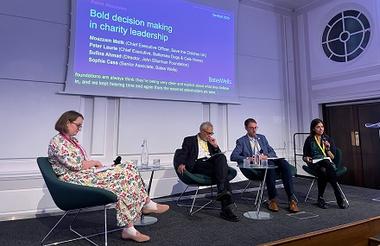
Moazzam Malik, chief executive of Save the Children UK, told an event yesterday that his organisation had “bureaucratised” itself since its founding in 1919 by Eglantyne Jebb and Dorothy Buxton, with the former arrested that year for distributing leaflets in Trafalgar Square.
“I think over decades, actually, the capacity for boldness has become constrained,” said Malik, “and particularly when a funding climate turns, and it is a difficult funding climate for civil society organisations.
“And indeed in a climate where civil society in many, many countries around the world is under pressure. That risk aversion can kick in very easily.”
Malik said Save the Children was focusing its campaigning efforts on “issues that are systemic” such as the ongoing conflict in Gaza and the UK’s now-removed two-child benefit cap.
“We tried to think about, of all the things that we could do, which are the ones that have systemic consequences,” he told the Bates Wells Spotlight Conference in London.
‘Shape the narrative’
Speaking on the same panel, John Ellerman Foundation director Sufina Ahmad said sector organisations “spend a lot of time trying to fix the system as it is, and not enough time thinking about the system as it could be, as it should be, as it needs to be”.
She said organisations needed to start to “shape the narrative rather than always reacting to the narrative”.
As a funder, she said her organisation was now “very explicitly and clearly about only wanting to work with change-making organisations that are committed to advancing justice and doing so in partnership with impacted communities”.
Ahmad said foundations as hers played an important role as funders independent from government and were “able to operate and think in the long term in a way that lots of charities aren’t”.
“We are wealthy, often, and even the fundraising ones tend to be able to fundraise in a way that peer organisations or other fundraising organisations might struggle with.
“And so we have a duty, I feel an obligation even, to put ourselves forward to be helpful and add value and ultimately contribute to systemic change.”
Charities ‘can offer credible reasons for hope’
Also speaking on the same panel, Battersea chief executive Peter Laurie said members of the public were “crying out for hope and for a future that they can believe in”, which he said charities could provide.
He said many charities can demonstrate what progress they have achieved over time and inspire action.
“We can offer credible reasons for hope, and I think if we can do that successfully, we will increasingly become increasingly important to society, and will become increasingly relevant,” he said.
Laurie added that the charity sector should be bolder in its collective narrative “about the value we bring to society” and what voluntary organisations need to achieve even more.
“I think sometimes as charities, we’re a little bit cautious, perhaps, in stating the importance of what we do individually but also collectively to the public, and also painting a picture that without us it could be pretty bleak,” he said.