


Every charity chief executive needs to be financially literate, a conference has heard.
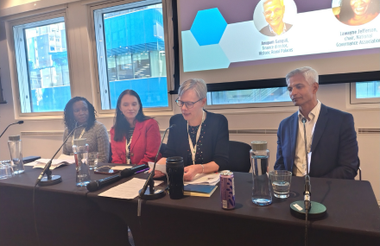
Felicia Willow, interim CEO and charity governance consultant, made the remark yesterday at Civil Society Media’s Charity Finance Summit when speaking on a panel.
The panel discussed how finance directors can move beyond spreadsheets to tell a compelling story that resonates with non-financial trustees and supports better decision-making.
Asked what to do if a charity’s finance person communicates predominantly with the chair to the exclusion of the rest of the board, Willow said: “When you come in after a CEO who’s not financially literate, there’s such a vulnerable weak spot in that finance role.
“So, making sure that your CEO is an active part of that conversation – and I don’t mean they have to be a qualified accountant – but they need to be financially literate.
“That can do a lot to break those silos and make sure those conversations are happening. Also, you’ve got that strategic financial flow that goes across the organisation, not just the finance things alone.”
Gap between finance people and rest of the board
Attendees heard that every trustee should be on top of their charity’s finances, with problems potentially arising when the board fails to properly engage with them.
Anupam Ganguli, finance director at Historic Royal Palaces, said: “Trustees, by not looking at the finances and financial governance of the charity, aren’t fulfilling one of their fundamental responsibilities.
“You can’t really be an effective trustee; you can’t say that you fulfil your responsibility and duty as a trustee if you haven’t been looking at the finances.”
Lawayne Jefferson, chair of the National Governance Association, argued that sometimes, trustees can avoid finance items when faced with “complex, dense financial spreadsheets”.
She said “transparency, clarity, inclusion, accuracy and credibility” is key in governance. “Trustees switch off because it’s dense, complex and not clear, and they risk approving something that’s totally wrong.
“The move to a more narrative-based financial reporting process is absolutely great.”
On this, Willow said that often trustees do not fully understand their responsibilities.
“They don’t recognise that finance is part of their inherent role as a trustee, so that’s definitely one problem,” she said.
“Another problem I see a lot is when you have highly qualified, competent treasurers who are fantastic at doing these complicated reports, but have no idea how to make them make sense to people who aren’t that financially literate.
“There’s sometimes a big gap between the finance people and the rest of the board.”
‘Treat trustees as critical friends’
Ganguli said charity finance teams also have a responsibility for building trustees’ financial understanding and confidence.
He said: “Treat a trustee as a critical friend and remember: you know more about the charity than they do. They may know lots of other things, but you know more about it, and it doesn’t have to be just those regular meetings.
“I benefit more from those quick, informal chats through the year. It’s important to build up that relationship with your finance director or finance trustees. You can feel that you have that sort of mutual trust and respect between you. That’s incredibly important.”