

Charity leaders have been urged to take a more proactive approach to managing their organisations’ interaction with AI at an event this week.
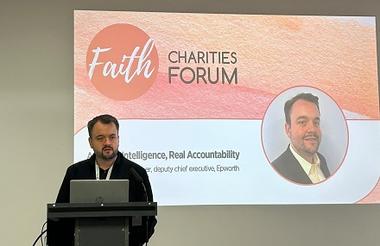
Speaking at the Faith Charities Forum in London yesterday, Epworth Investment Management deputy CEO Andrew Harper also cautioned that many charities’ services would be impacted by the technology’s “uncontrolled rise”.
The Christian investment manager’s deputy CEO cited research that suggests AI use among charities is outpacing its governance.
Harper said that charities, especially smaller ones, can benefit from enabling AI to complete admin tasks.
“A small charity that can suddenly write decent bids, produce materials in 11 languages, and stop losing its evenings to admin is working more hours for people,” he said.
However, Harper advised against letting the technology make more nuanced decisions.
He argued that AI lacks accountability and allowing it to vet, approve or reject people seeking charitable services would be a mistake.
“Accountability requires somebody to be answerable, and a system, a computer, cannot repent,” Harper said.
“Any decision that turns a human being away, any decision involving a child or an adult at risk, any decision a person might reasonably want to appeal, those [must] stay with a named human being who can be asked why.”
Charity investments challenged
Civil Society Media’s event, Harper said that AI frontier models such as ChatGPT, Claude and Grok – owned and developed by five to six tech companies – are, in part, funded by charities.
He referenced AI data centres which consume vast amounts of water and electricity as contributing to shortages for people who need it most, urging charities to address this with their fund managers.
“Before this becomes a comfortable talk about somebody else's sins, let me spoil it: there is no base – there is only us.”
“The capital that buys the shares is our capital,” Harper said. “The endowments and the reserves and the legacy funds are ours.
“Somewhere in the accounts, most of the organisations in this room, there is an exposure to precisely the companies I have described, and in most cases, it is among your largest holdings.”
Harper urged charity leaders to challenge fund managers about “contradictory” climate commitments and to better understand the adverse effects of AI on communities.
“A policy nobody has read is not governance; it is insulation,” he added.
Human cost
Harper also said that charity services such as youth employment programmes, debt advice, food banks and counselling would foot the bill for AI’s rapid expansion.
He argued that AI growth carried a human cost, especially for young people struggling to find jobs and housing.
“We are running this enormous, uncontrolled experiment on a generation that was not doing well to begin with,” he said.
“When the bill arrives, and it will arrive, it will not arrive at the technology companies – it will arrive at you [charities].”
He added: “I am asking you to notice that the gains and the costs land on different people, on different timescales, with different visibilities.
“That gap is the thing nobody is pricing, and charities are standing at the end of it with a queue outside the door.”