


Reserves are defined by Charities SORP 2026 as “that part of a charity’s unrestricted funds that is freely available to spend on any of the charity’s purposes”.
The calculation of reserves usually starts with unrestricted funds and then excludes resources that are not readily available for general spending, such as:
- Tangible fixed assets used in the charity’s operations.
- Social investments (where not readily available).
- Essential designated funds.
- Other committed amounts which are not freely available.
What the SORP requires
The SORP requires every charity to explain its policy on holding reserves, state the amount held and the reason, or explain why reserves are considered unnecessary.
The reported figure must agree with the accounts – or be reconciled either in the reserves policy or in a note. The trustees’ report must:
- Compare the amount of reserves with the charity’s reserves policy.
- Explain, where relevant, the steps the charity is taking, given the plans for the future activities of the charity, to bring the amount of reserves it holds into line with the policy.
Where reserves are zero (or net assets are negative), there must be an explanation of why the charity remains a going concern.
Setting a meaningful policy
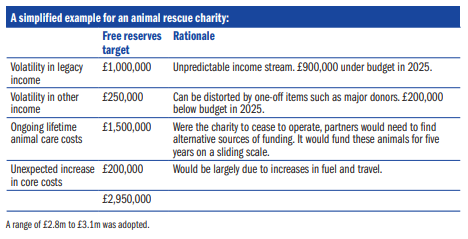
In determining the target, there should be consideration of operational and financial risks. There is no universally “correct” level.
A sensible approach is to start with the charity’s operating model and quantify the financial consequences of plausible events. This should consider areas such as:
- Income stability.
- Renewal dates of major grants and contracts.
- Inflation.
- Committed costs.
- Obligations to beneficiaries.
- Cost of an orderly reduction or closure.
- Other risks such as ongoing legal matters.
A target range is often more useful than a single figure because it recognises normal fluctuations while creating clear escalation points.
For each major risk assess likelihood, potential cash impact, speed of onset, available mitigation and whether existing funding could absorb it.
Stress-test the financial forecast for the loss of a major funder, delayed receipts, weaker fundraising, cost inflation or an operational incident.
Then translate the residual exposure into reserve needs, while avoiding double-counting risks already insured, contractually recoverable or covered by restricted funding.
Cash flow remains critical
It’s important to note that reserves are not the same as cash. Investments, receivables or unrestricted property may support the balance sheet position overall and increase the free reserves balance, but cannot necessarily help meet payroll or other payments in the timeframe needed.
Charities should maintain a rolling cash flow forecast, updated on a periodic basis. This enables trustees and management to look ahead and anticipate pressures with time to act.
It allows for informed decision-making around spending, recruitment, investment drawdowns and fundraising activities. This also feeds back into the considerations around free reserves by indicating the level of reserves needed to mitigate financial risks.
Nicky Whitehead is a director at HaysMac