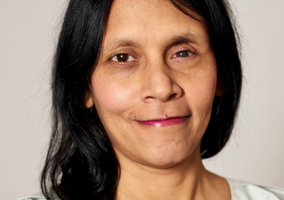


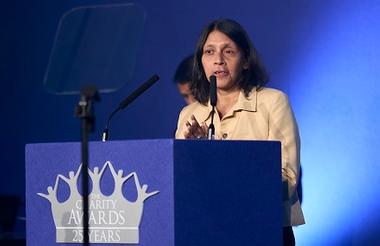
An Oxfam trustee has criticised the “brutal” dismissal of the charity’s chief executive who had allegedly filed a grievance complaint against its former chair.
Civil Society understands that Halima Begum had lodged a grievance complaint related to "sexism, racism and bullying" against former chair Charles Gurassa prior to being ousted last week.
Gurassa stepped down as chair last month. Oxfam GB trustee Balwant Singh said Begum had filed her complaint against Gurassa before she became aware of concerns around her leadership.
Begum, appointed Oxfam CEO in 2023, left the charity after “serious concerns” were raised over governance at the organisation. This followed an independent review by trustees into her leadership.
Oxfam GB has now submitted a “serious incident report” regarding its leadership to the Charity Commission.
Singh said that before Begum’s departure, a group of white Oxfam staff and a senior colleague from the global south, in November, wrote to the board about racism faced by Black, brown and other Black, indigenous and people of colour members.
He said: “There is an entrenched culture at Oxfam, which is a serious concern and it pre-dates Halima’s term.
“No investigation [into racism] has been initiated and no other action has been taken to-date.”
Begum’s lawyer told the Times yesterday that she would be taking legal action against Oxfam for “defamatory and unfounded criticism” of her.
The Sunday Times reported that Begum was forced to stand down by Oxfam’s board on Friday after it found “serious issues” with her decision-making and behaviour amid accusations of bullying.
Some 70 staff members signed an open letter petitioning Oxfam to investigate Begum’s conduct, it reported, stating that multiple employees had resigned after disputes with her.
Singh, however, said that Begum was a victim of a plot to undermine her leadership.
He claimed: “It is sickening that Halima has been subjected to what appears to be a carefully orchestrated and intentionally brutal retaliation and retribution in the national media.”
Singh, who has been on the Oxfam board for more than three years, said the statement released by the charity did not reflect his views as a trustee.
Yet Oxfam, in a statement yesterday, claimed Singh had supported the decision to remove Begum.
An Oxfam spokesperson said: “It is disappointing to know that a trustee who independently backed this unanimous decision is now deciding to publicly question a board resolution they were part of determining.
“We take seriously the voices of colleagues who may have experienced racialised bias or harm.”
Singh told Civil Society that he had supported Begum’s departure due to “organisational culture and governance conditions” at the charity rather than her performance as CEO.
Gurassa said it was an “enormous privilege” to serve as Oxfam GB chair for five years. He said he stood down at a November board meeting when his term came to an end.
Reaction from across the sector
Matthew Johnson, chief executive of Race on the Agenda, who worked with Begum at the Runnymede Trust, said she was a “warm, caring and fearless woman” and urged people to reserve judgement.
Posting on LinkedIn, he said: “I encourage all to resist rushing to judgement, look beyond simplified headlines, and let the facts emerge.
“She inherited a deeply challenging situation at Oxfam of financial and internal instability, including acknowledged problems with systemic and structural racism.”
However, Natasha Burgess, a former Unite the Union representative at ActionAid during Begum’s short stint as chief executive there in 2023, commended Oxfam’s decision.
Burgess, on LinkedIn, said: “There are lessons here from this clear, fair and confident approach.
“I want to send my solidarity to Unite the Union reps and members at Oxfam.”
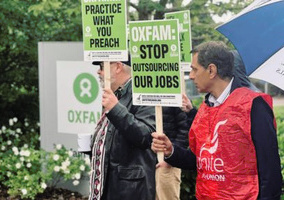
Jamie Major, Unite regional coordinating officer, said Oxfam’s workforce was “very demoralised”, a problem “exacerbated by a poorly handled redundancy programme”.
Earlier this year, more than 140 staff members were made redundant as part of restructure meant to address Oxfam’s second consecutive annual operating deficit of £20m.
Akiko Hart, Liberty director, said Begum had inherited a £16m deficit which she tackled through a “painful but necessary restructure”.
Hart said: “I would invite people to reflect on the timing of this announcement, at the tail end of a painful restructure which was approved by the board, and a few weeks after the resignation of the chair.”
Editor’s note: This article was updated on 17 December 2025 to add a further detail about Balwant Singh’s comments to the Oxfam board.