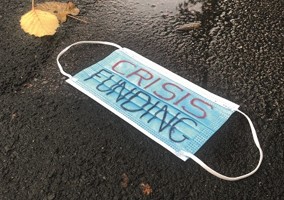



Government funding dedicated to supporting the charity sector during the pandemic was “not fast enough” to be delivered and “too small”, the former NCVO chief executive told the ongoing Covid-19 inquiry yesterday.
Sarah Elliott, the umbrella body’s CEO from January 2020 until September this year, told the inquiry that charities faced “a perfect storm of declining income, and indeed declining resources more broadly in terms of volunteers, at a time of increased costs and increased need in communities” during the pandemic.
Elliott described a decline in donations and fundraising due to lockdowns, as well as a drop in investment income, adding that many charities were “most needed during the pandemic, and needed to step up to meet that increased need, and so actually required additional resources and additional funding to be able to do that”.
She was critical of the £750m funding package announced by then-chancellor Rishi Sunak in April 2020 to support charities, noting that while the sector was grateful for the funding, the support scheme was “not designed with charities and therefore difficult to access”.
“And even the specific support scheme for charities was quite late in being announced, and probably not as substantial as it needed to be to respond to the need in communities that the sector was supporting,” she said.
The sector previously criticised the then Conservative government’s support schemes for charities during the pandemic.
Funding pot ‘too small’
Elliott added that the announcement of the £750m support scheme “was not soon enough” and that “many charity leaders in those first few weeks of lockdown were facing impossible decisions”.
“It takes time to reduce the size of an organisation in terms of making staff redundant, and charity leaders were calling me on an almost daily basis asking when support was coming, was support going to be announced, because they and their boards were facing impossible decisions,” she said.
“So it was not quick enough, in my opinion.”
When asked to elaborate by inquiry chair, Baroness Hallett, Elliott said that the sector had several concerns with the support scheme once it had been announced.
“It needed to be substantial, swift and simple,” she said. “And in my view, it fell short on all those counts.
“In terms of swift, as I’ve already outlined, we thought it took too long. In peacetime, it would have been an extremely fast announcement of funding, but given the crisis, given the impossible decision charity leaders were making about their organisations, it wasn’t fast enough.”
Elliott also expressed concern about the size of the funding, adding “compared to, for example, the arts sector, as a proportion of the sector’s overall income, it was not enough. It was too small”.
“We felt that, in making decisions, other DCMS sectors were perhaps prioritised over the sector at the start of the pandemic,” she said.
Elliott said that although the crisis response fund was “welcome and needed”, many charities “needed to also stabilise”.
She said that those charities that were not responding to the immediate crisis were ineligible for the scheme yet “still essential to the recovery of the country”.