

Charities have been encouraged to address how they censor their campaigning activities and to confront concerns expressed by stakeholders.
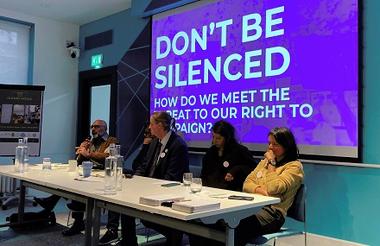
At an event in London yesterday – called Don’t Be Silenced, Protecting Our Right to Campaign – sector leaders were asked whether charities were prevented by cautious trustees, funders and regulators from showing solidarity with other organisations.
Speaking on a panel, co-executive director of Greenpeace Areeba Hamid said some censorship of charities was “self-made” and encouraged sector leaders to “lean into” discussions with trustees and funders over campaigning activity.
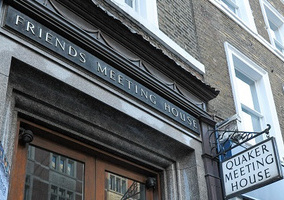
She told the event at Friends House organised by Speak Out that there could be “tension” with trustees over how charity laws are interpreted but that leaders needed to engage with their concerns.
“And similarly, with philanthropists,” she added. “I think there is an education piece. I completely understand that. We have the luxury of not being funded by philanthropists so much. But it is true. That tension is really real.
“The people behind the scenes who are funding this movement are either agnostic or against lots of things that we’re saying. So there is a piece we need to do there.”
Large charities play ‘oversized role’
New Economics Foundation chief executive Danny Sriskandarajah said larger charities played an “oversized role” in civil society due to their resources and access to governments.
Sriskandarajah, who previously led Oxfam, said there was therefore a “special responsibility” for larger organisations to “stand in solidarity with the rest of civil society” particularly on issues different to their own.
He also expressed concern over charities’ relationships with supporters, which he said could become “extractive” if based primarily on sourcing donations.
“You’re just there for the money, you know, the donation to keep your business model going, not to think of your supporters as members, as real stakeholders,” he said.
Asad Rehman, CEO of Friends of the Earth, reflected on his previous leadership of anti-poverty charity War on Want.
He said the charity understood its role in civil society as being bold in its campaigning “to show the rest of the sector that it’s possible to say the things and do things and speak about things in the way we were without fear”.
As a result, he said the commission did investigate War on Want but the charity tried to resist any restrictions on its campaigning freedoms.
“I think there is a self-censorship within the sector where we either say our boards won’t agree with this, or our members […] will think this is weird,” he said.
Rehman added: “We have to explain why the right to protest is a critical part of us playing our role in the wider ecosystem.
“That if we want to build power, we have to build power of the movement and which we are just one integral part.”
‘Quieter’ solidarity
Shabna Begum, chief executive of Runnymede Trust, said it was possible for charities to show solidarity with other organisations in private conversations as well as their public campaigning.
“Solidarity can be quiet,” she said. “It can be having the conversation where, where you speak to a funder and you direct the funder to a conversation.
“It can be the access to a colleague, a parliamentary colleague, who may be able to make a difference.
“These are quiet acts of solidarity, and we neglect those often to kind of go from the loud public statements that make us feel good, but actually don’t really achieve much. And I think we need to be thinking about solidarity in those quieter, less visible, less glorious spaces and connections.”